
Newsletter
Can Interpreting a Claim Feature As Means-Plus-Function or Step-Plus-Function Language Address Challenges Posed by Prior Art?
"Means-plus-function language" or "step-plus-function language" in a patent claim is generally directed to a technical feature drafted as "a device/object (or a step) for achieving a specific function" (for example, "a device for wrapping a wire extruded from A") without further describing the specific structure, material, or act of such "device/object" or "step." To prevent a technical feature drafted in such manner from being broadly construed to cover all devices or steps capable of achieving the function, which would extend beyond the disclosure of the patent specification and drawings, Paragraph 4, Article 19 of the Enforcement Rules of the Patent Act specifically provides: "When interpreting technical features in a claim(s) expressed in means-plus-function language or step-plus-function language, the structure, material, or act described in the specification as corresponding to such function, and equivalents thereof, shall be included."
If a technical feature in a patent claim is primarily described in terms of its function, thus appearing to be a means-plus-function or step-plus-function term, the patentee or the applicant, when facing challenges to novelty or inventive step based on prior art, may take advantage of the aforementioned provision to assert that such feature constitutes "means-plus-function" or "step-plus-function" language, and further argue that, in comparison with the prior art, the corresponding structure, material, or act disclosed in the patent specification for performing the claimed function should be incorporated as part of the construed features of the claim. Consequently, a feature that sufficiently distinguishes the means- or step-plus-function language from the prior art may be identified to substantiate the validity of the patent claim.
However, this approach is not always effective. The 114-Min-Juan-Su-13 Judgment rendered by the Intellectual Property and Commercial Court in January 2026 (hereinafter referred to as "the Judgment") serves as an example. In this case, to demonstrate a distinction between the features of Claim 1 of the Patent at issue and the prior art, the patentee (plaintiff) argued that the phrase "a connecting plate 1 and a connecting plate 2 combined with a rotating shaft tube for forming an upper portion which is tightly joined, air-permeable and lightweight" as specified in Claim 1 of the Patent at issue (TWM647163) constitutes means-plus-function language; accordingly, "connecting plate 2" should be interpreted as having the specific structures (i.e., the L-shaped plate) disclosed in the corresponding embodiment of the specification and drawings of the Patent at issue.
However, the court did not accept the patentee's argument for the following reasons:
1. The court set forth the principles for determining whether a term is a means-plus-function or step-plus-function term: "Determination of whether a term is a means-plus-function or step-plus-function term should be judged based on the following conditions: (1) The technical feature is described using the language 'means for' (or 'device for') or 'step for.' (2) The 'means for' (or 'device for') or 'step for' language must specify a particular function. (3) The 'means for' (or 'device for') or 'step for' language must not recite sufficient structure, material, or act for performing the specific function."
2. The court held that a person having ordinary skill in the art, based on the technical features defined in Claim 1 of the Patent at issue—namely, "the height of the tube body being raised, and a connecting plate 1 and a connecting plate 2 combined with a rotating shaft tube for forming an upper portion which is tightly joined, air-permeable and lightweight"—would understand that the specific function of "being tightly joined, air-permeable, and lightweight" can be achieved by combining a connecting plate 1, a connecting plate 2 and a rotating shaft tube to form the upper portion.
3. The court further held that: Although the plaintiff argued that the specific shape of connecting plate 2 disclosed in the drawings (i.e., element 6 having the "L-shaped plate body" structure) should be interpreted as part of the technical features of Claim 1, the shape feature asserted by the plaintiff can only be inferred from the drawings; the specification of the Patent at issue does not describe the structure of the connecting plate 2 (6). Therefore, the plaintiff's argument is not acceptable.
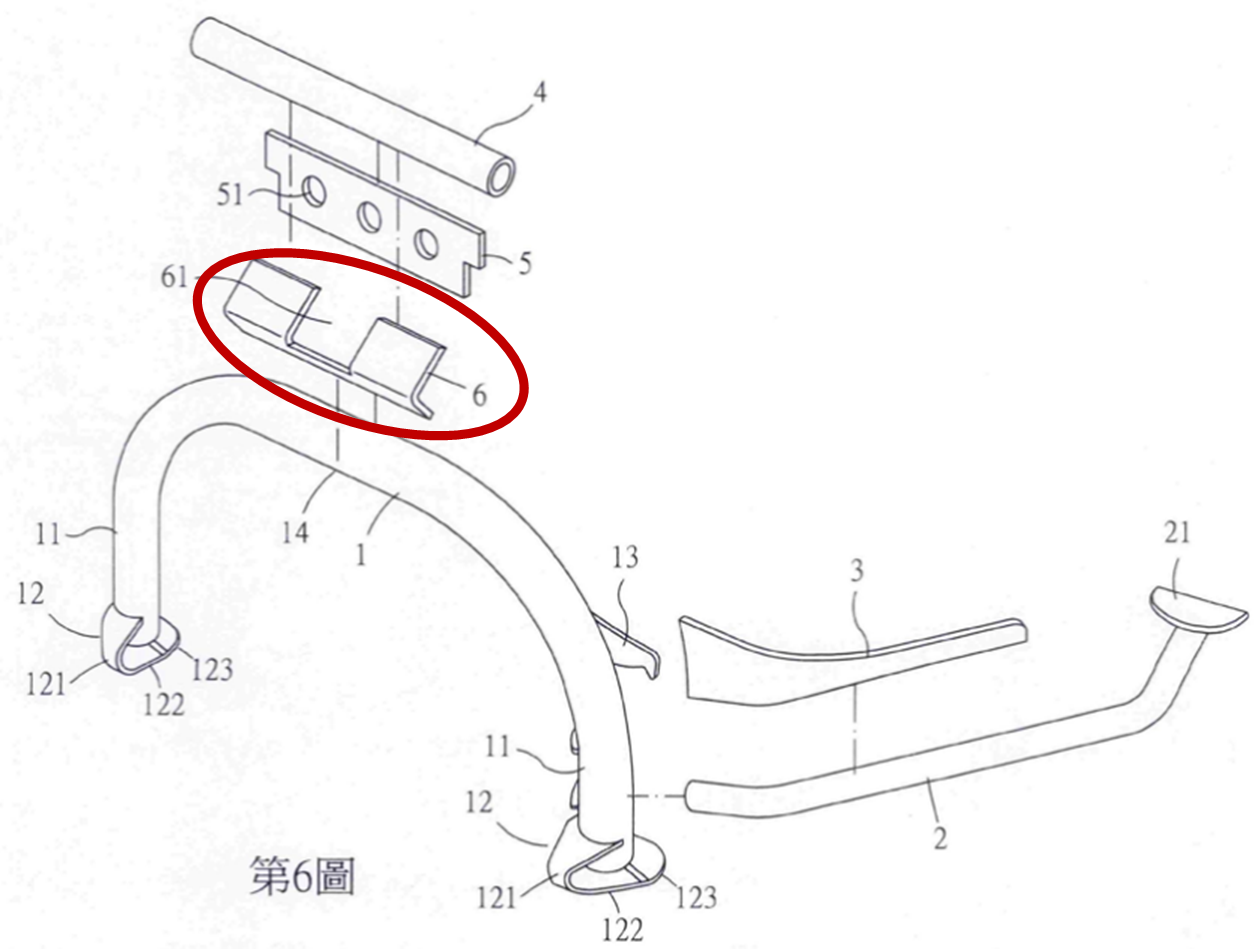
In fact, it can be observed that there is very limited description regarding the structure and materials for achieving the function of "being tightly joined, air-permeable, and lightweight" in connection with the connecting plate 2 in the specification of the Patent at issue. The specification merely indicates "the upper portion of the tube body 1 is formed by tightly combining the rotary shaft tube 4 with the connecting piece 5 and the second connecting piece 6, forming an open space without covering...." This description in the specification is not much different from that in Claim 1. It can be inferred that if the court had not determined that the description in Claim 1 is sufficient to enable a person having ordinary skill in the art to understand the specific means by which the Patent at issue achieves the function of "being tightly joined, air-permeable and lightweight," the disclosure of the specification of the Patent at issue would not have been considered to meet the enablement requirement.
Therefore, if a patentee intends to interpret a claimed feature using the means-plus-function or step-plus-function claim construction to limit the claim scope to the corresponding structure, material, and act disclosed in the specification to survive a prior art challenge, the specification should disclose at least one embodiment that provides a complete description of the structure(s), material(s), and act(s) corresponding to the means-plus-function or step-plus-function language.